Wednesday, August 28, 2013

Protein that delays cell division in bacteria may lead to the identification of new antibiotics

Scientists at Washington University have worked out how two bacterial strains delay cell division when food is abundant, an understanding that might be used to design drugs that stop division entirely

Levin lab
In a rapidly dividing chain of bacterial cells (top), constriction rings that will pinch the cells in two appear in red. The red doughnut to the bottom right of the image is a constriction ring seen head on rather than from the side. In the middle, an image of the constriction rings (red) has been overlaid on one of the cell walls (green), The bottom image shows the constriction rings (red) and the bacterial DNA (blue). Scientists at Washington University in St. Louis are learning exactly how the bacteria control the assembly of the constriction rings and thus the timing of cell division.

Monday, August 26, 2013

Creating plants that make their own fertilizer

Washington University biologists are undertaking an ambitious project to engineer tiny nitrogen-fixing devices within photosynthetic cells.

James Byard/WUSTL
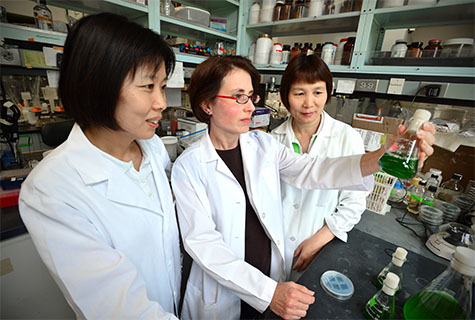
Nancy Duan (left), Michelle Liberton and Lingxia Zhao are members of Himadri Pakrasi’s team, which has taken the first proof-of-principle steps toward inserting the genes needed to fix nitrogen — otherwise found only in bacteria and the bacteria-like Archae — into the cells of crop plants.
Since the dawn of agriculture, people have exercised great ingenuity to pump more nitrogen into crop fields. Farmers have planted legumes and plowed the entire crop under, strewn night soil or manure on the fields, shipped in bat dung from islands in the Pacific or saltpeter from Chilean mines and plowed in glistening granules of synthetic fertilizer made in chemical plants.

No wonder biologist Himadri Pakrasi’s team is excited by the project they are undertaking. If they succeed, the chemical apparatus for nitrogen fixation will be miniaturized, automated and relocated within the plant so nitrogen is available when and where it is needed — and only then and there.

“That would really revolutionize agriculture,” said Pakrasi, PhD, the Myron and Sonya Glassberg/Albert and Blanche Greensfelder Distinguished University Professor in Arts & Sciences and director of the International Center for Advanced Renewable Energy and Sustainability (I-CARES) at Washington University in St. Louis.

READ MORE ABOUT THIS

Thursday, February 7, 2013

Blood-clotting disorders

New center to study bleeding disorders and clot formation


Researchers at Washington University School of Medicine have received a $9 million grant to investigate blood-clotting disorders. From heart attacks and strokes to uncontrolled bleeding, clotting disorders cause more deaths each year in the United States than all types of cancer combined.


Strands of a protein called von Willebrand Factor (orange) play a key role in blood clotting. Secreted by cells lining the blood vessels, the strands capture platelets and initiate the formation of blood clots

“Blood clots in veins and arteries remain one of the great killers,” says principal investigator J. Evan Sadler, MD, PhD, professor of medicine and chief of the Division of Hematology. “The goal of this grant is to shorten the time between a new discovery in blood clotting or bleeding disorders and the application of that knowledge to help patients.”

Washington University is one of only five universities across the country receiving funding from the National Heart, Lung, and Blood Institute (NHLBI) to support a new Translational Research Center in Thrombotic and Hemostatic Disorders.

READ MORE


Monday, September 17, 2012

DBBS faculty member Lihong Wang receives $3.8 million NIH Director’s Pioneer Award.

Lihong Wang, PhD, has received a National Institutes of Health (NIH) Director’s Pioneer Award to explore novel imaging techniques using light that promise significant improvements in biomedical imaging and light therapy.
Lihong Wang

One of only 11 recipients of the highly competitive award, Wang was selected from among 600 applicants. The award supports individual scientists of exceptional creativity who propose pioneering — and possibly transforming — approaches to major challenges in biomedical and behavioral research, according to the NIH.

The award will provide Wang with a total budget of $3.8 million over five years.

Wang, the Gene K. Beare Distinguished Professor of Biomedical Engineering at Washington University in St. Louis, says his research will explore transporting light into the body’s tissues far beyond the classical penetration limits for high-sensitivity imaging and low-side-effect therapy.

“I am honored to have received this award from among such a competitive group,” Wang says. “This award will allow us the intellectual freedom and resources to develop a brand new technology. If successfully implemented, it would impact many disciplines of biomedicine with applications, including imaging, such as functional brain imaging and reporter gene imaging; sensing (oximetry and glucometry); manipulation (optogenetics and nerve stimulation); and therapy (photodynamic therapy and photothermal therapy).”

A leading researcher on new methods of cancer imaging, Wang has received more than 30 research grants as the principal investigator with a cumulative budget of more than $38 million. His research on non-ionizing biophotonic imaging has been supported by the NIH, National Science Foundation (NSF), the U.S. Department of Defense, The Whitaker Foundation and the National Institute of Standards and Technology.

More.....

Wednesday, July 25, 2012

Scientists read monkeys’ inner thoughts

By decoding brain activity, scientists were able to “see” that two monkeys were planning to approach the same reaching task differently — even before they moved a muscle.


Moran/Pearce

In the classic center-out reaching task, a monkey reaches from a central location to targets on a circle surrounding the starting position. This task does not allow the neural encoding for hand position to be separated from the neural encoding for hand velocity. If the starting position varies, however, as in the task shown here, hand position and initial hand velocity can be disambiguated.

Anyone who has looked at the jagged recording of the electrical activity of a single neuron in the brain must have wondered how any useful information could be extracted from such a frazzled signal.

But over the past 30 years, researchers have discovered that clear information can be obtained by decoding the activity of large populations of neurons.

Now, scientists at Washington University in St. Louis, who were decoding brain activity while monkeys reached around an obstacle to touch a target, have come up with two remarkable results.

Their first result was one they had designed their experiment to achieve: they demonstrated that multiple parameters can be embedded in the firing rate of a single neuron and that certain types of parameters are encoded only if they are needed to solve the task at hand.

Their second result, however, was a complete surprise. They discovered that the population vectors could reveal different planning strategies, allowing the scientists, in effect, to read the monkeys’ minds.

By chance, the two monkeys chosen for the study had completely different cognitive styles. One, the scientists said, was a hyperactive type, who kept jumping the gun, and the other was a smooth operator, who waited for the entire setup to be revealed before planning his next move. The difference is clearly visible in their decoded brain activity.

The study was published in the July 19 advance online edition of the journal Science.

READ MORE

Monday, June 25, 2012

Unraveling the Brain’s Process for Predicting the Future


Jeffrey Zacks
Associate Professor Jeffrey M. Zacks studies
 the brain’s process for predicting the future. (David Kilper)


Every day we make thousands of tiny predictions — when the bus will arrive, who is knocking on the door, whether the dropped glass will break. Now researchers are unraveling the process by which the brain makes these prognostications.

Predicting the near future is vital in guiding behavior, says Jeffrey M. Zacks, PhD, associate professor of psychology.

“It’s valuable to be able to run away when the lion lunges at you, but it’s ­super valuable to be able to hop out of the way before the lion jumps,” he says.

Zacks and his colleagues believe that a good part of predicting the future is maintaining a mental model of what is happening now. Occasionally this model needs updating, especially when the environment changes unpredictably.

In the study, volunteers watched movies of everyday events such as washing a car or building a LEGO model. When researchers stopped the movie, participants predicted what would happen next.

Sometimes the movie stopped when a new occurrence was about to take place. Other times, the researchers stopped the movie in the middle of an event. They found that participants correctly ­predicted activity within the event more than 90 percent of the time; they correctly predicted across the event boundary less than 80 percent of the time.

Zacks says the experiments offer hope of targeting prediction-based ­updating mechanisms to better diagnose early stage neurological diseases and provide tools to help patients.

Read more about this study in the university’s Newsroom

Tuesday, June 5, 2012

World’s largest hunk of cancer genome data released

To speed progress against cancer and other diseases, the St. Jude Children’s Research Hospital-Washington University Pediatric Cancer Genome Project has announced the largest release to date of comprehensive human cancer genome data for free access by the global scientific community.

The amount of information released more than doubles the volume of high-coverage, whole-genome data currently available from all human genome sources combined. This information is valuable not just to cancer researchers, but also to scientists studying almost any disease.

The release of this data was announced as a part of a perspective published online May 29 in Nature Genetics.

The 520 genome sequences released are matched sets of normal and tumor tissue samples from 260 pediatric cancer patients. The Pediatric Cancer Genome Project is expected to sequence more than 1,200 genomes by year’s end. Each sample is sequenced at a quality control level known as 30-fold coverage, ensuring maximum accuracy. The St. Jude and Washington University researchers are analyzing the genomic sequences to determine the differences between each child’s normal and cancerous cells to pinpoint the causes of more than a half-dozen of the most deadly childhood cancers, an effort which has already produced a number of key discoveries reported in top scientific journals.
 
“This effort has generated more discoveries than we thought possible,” says James Downing, MD, St. Jude scientific director who leads the project at St. Jude. “We want to make this information available to the broader scientific community so that, collectively, we can explore new treatment options for these children. By sharing the information even before we analyze it ourselves, we’re hoping that other researchers can use this rich resource for insights into many other types of diseases in children and adults,” he said.

READ MORE

Tuesday, May 22, 2012

Bonni to lead anatomy and neurobiology department

Azad Bonni, MD, PhD, currently professor of neurobiology at Harvard Medical School, will be the next head of the Department of Anatomy and Neurobiology at Washington University School of Medicine in St. Louis.


Bonni becomes the Edison Professor and head of Anatomy and Neurobiology in October 2012. Larry J. Shapiro, MD, executive vice chancellor for medical affairs and dean of the School of Medicine, made the announcement.

“The Department of Anatomy and Neurobiology has a very distinguished history of leadership and innovation in its field,” Shapiro says. “We are confident that Dr. Bonni, who has produced many remarkable insights into brain development, will support and expand those traditions.”

Bonni studies how the brain is built at the level of individual connections between nerve cells. Key areas of his research include studies of the mechanisms that regulate the development of nerve cells and their ability to connect with each other in the brain. His lab is currently focused on the role of transcriptional and ubiquitin signaling in these processes. He also investigates how those mechanisms can contribute to neurological diseases when they go awry.

“The opportunity to lead the Department of Anatomy and Neurobiology at Washington University School of Medicine is a great honor,” Bonni says. “Research at Washington University has had a lasting impact in the establishment of neuroscience as a discipline, and the Department of Anatomy and Neurobiology has played a central role.”

READ MORE


Tuesday, May 8, 2012

Alzheimer's trials

Grant to fund first clinical trials aimed at Alzheimer's prevention


The School of Medicine has received nearly $4.2 million from the Alzheimer’s Association to accelerate the launch of the first clinical trials to prevent the symptoms of Alzheimer’s disease. The award is the largest research grant in the history of the 32-year-old association.

Randall J. Bateman, MD, principal investigator of the grant and director of the Dominantly Inherited Alzheimer’s Network (DIAN) Therapeutic Trials Unit at Washington University, will lead the trials, which will determine if the disease can be halted or delayed before problems in memory and other brain functions become apparent.

The research will be conducted through the DIAN, an international research partnership focused on understanding inherited forms of Alzheimer’s. DIAN is headed by John C. Morris, MD, the Harvey A. and Dorismae Hacker Friedman Professor of Neurology. Bateman and Morris treat patients at Barnes-Jewish Hospital.

READ MORE

Thursday, May 3, 2012

Supporting life sciences

Doctoral students named first Monsanto graduate fellows

Washington University has received a $930,000 grant from the Monsanto Co. to support graduate student research in life sciences. The grant, to be distributed over the next seven years, will establish a Monsanto graduate fellowship program.

Each year, two graduate students pursuing doctoral degrees in the university’s Division of Biological and Biomedical Sciences (DBBS) will be selected as fellows. Life sciences include plant sciences, microbiology, biochemistry, immunology, genetics and other specialties.

Jordan K. Teisher, a doctoral student in evolution, ecology and population biology, and Jeremy D. King, a doctoral student in plant biology, have been named the first Monsanto graduate fellows.

“Through this fellowship program, Monsanto is giving Washington University graduate students a unique opportunity to be exposed to the breadth of research in life sciences,” says Stephen M. Beverley, PhD, the Marvin A. Brennecke Professor of Molecular Microbiology and chair of the executive council of the DBBS.

As fellows, the students will be taught how to run laboratory research programs. They also will have the opportunity to interact with Monsanto scientists to gain experience in a corporate research environment.


Monday, November 7, 2011

Washington People: Rochelle Smith

DBBS Staff Member Rochelle Smith is featured in this week's RECORD:

Rochelle Smith (second from left) talks with students (from left) David Cotter, Paige Cooper and Donell Carey, all graduate students in the Division of Biology and Biomedical Sciences, about volunteer opportunities.


Rochelle Smith has a knack for recruiting underrepresented graduate students in the sciences to Washington University.


In the past five years, the number of minority students entering graduate programs each year in the biomedical sciences has almost tripled, as have the number of students entering the Medical Scientist Training Program (MSTP) and the Division of Biology and Biomedical Sciences’ (DBBS) summer research programs for undergraduate students. She travels the country to recruit students and finds ways to bring them to the university so they can see it firsthand.

Smith is director of diversity, summer programs and community outreach for DBBS. She is known for her magnetic personality that puts students, faculty and staff at ease.

“Rochelle represents the best of WUSTL,” says Brian Sullivan, executive director of the university’s MSTP. “She balances her commitment to excellence and effectiveness with a concern for the individual, which results in changes not only to structures but also to hearts and minds.”

READ MORE


Wednesday, October 5, 2011

Natural compound helps reverse diabetes in mice

Researchers (from left) Shin-ichiro Imai, MD, PhD, Jun Yoshino, MD, PhD, and Kathryn Mills showed that a natural compound, NMN, helps to treat symptoms of diabetes in mice. Photo by: Julia Evangelou Strait

Researchers at Washington University School of Medicine in St. Louis have restored normal blood sugar metabolism in diabetic mice using a compound the body makes naturally. The finding suggests that it may one day be possible for people to take the compound much like a daily vitamin as a way to treat or even prevent type 2 diabetes.

This naturally occurring compound is called nicotinamide mononucleotide, or NMN, and it plays a vital role in how cells use energy.

"After giving NMN, glucose tolerance goes completely back to normal in female diabetic mice,” says Shin-ichiro Imai, MD, PhD, associate professor of developmental biology. “In males, we see a milder effect compared to females, but we still see an effect. These are really remarkable results. NMN improves diabetic symptoms, at least in mice.”

The research appears online Oct. 4 in Cell Metabolism.

READ MORE

DBBS Faculty Member wins prestigious Presidential Early Career Award

The White House announced Sept. 27 that Lan Yang, PhD, assistant professor of electrical and systems engineering in the School of Engineering & Applied Science at Washington University in St. Louis, has been named a recipient of the Presidential Early Career Awards for Scientists and Engineers (PECASE).

The early career award is the highest honor bestowed by the United States government on science and engineering professionals in the early stages of their independent research careers. This year, there are 94 recipients.

“It is inspiring to see the innovative work being done by these scientists and engineers as they ramp up their careers — careers that I know will not only be personally rewarding but also invaluable to the nation,” President Barack Obama said in the award announcement. “That so many of them are also devoting time to mentoring and other forms of community service speaks volumes about their potential for leadership, not only as scientists but as model citizens.”

“I am pleased that the President has honored Lan with this special award for her world-class record of achievement,” says Ralph S. Quatrano, PhD, dean of the School of Engineering & Applied Science.

“She is a model for other assistant professors, and I have great confidence in her potential for continued future success. As only the fourth assistant professor at Washington University to receive this prestigious recognition since its inception 15 years ago, this award brings great visibility to Lan and her innovative work and to our school and university,” Quatrano says.


READ MORE

Monday, September 12, 2011

Restoration as science: case of the collared lizard

In a time when a five-year grant is considered a long-term grant, Alan R. Templeton, PhD, a professor of biology in Arts & Sciences at Washington University in St. Louis, has managed to follow some of the species he studies for 10, 20 or even 30 years.


Early in his career he studied parthenogenesis, or virgin birth, in fruit fly populations at a dump and in cactus patches in Hawaii.

“Drosophilia have fast generation times,” he says, “but I studied them for 12 years. And because I followed them for 12 years, I saw patterns I wouldn’t otherwise have seen. In fact, had I not stuck with it so long, I often would have made incorrect conclusions.”

But the fruitfly study is a sprint compared to his lizard work, described in the cover story of the September 2011 issue of Ecology. The Ecology article covers more than 20 years of a 30-year followup monitoring the reintroduction of collared lizards on Ozark glades in 1984. (For the story in pictures, see the slideshow to the right.)

During this time, 1,662 lizards living on 139 glades on three mountains were captured or recaptured 4,545 times. The acknowledgements section of the paper thanks more than 20 people for their help in capturing lizards.

The major revelation of the work was that burning entire mountains and valleys, called landscape-level burning, undid ecological damage that was slowed but not stopped by smaller prescribed burns.

In fact, it allowed the lizards to undertake their own expanded restoration effort without the assistance of worried biologists.

Moreover, burning benefited many species besides the lizards, including a rare fen orchid and fen dragonfly, that were flying under the radar and would probably never have commanded labor intensive restoration efforts on their own.

In short, fire turned restoration from a time-consuming labor-intensive process to one that ran pretty much on its own.

READ MORE

Wednesday, June 29, 2011

Sleep switch found in fruit flies

Rather than count sheep, drink warm milk or listen to soothing music, many insomniacs probably wish for a switch they could flick to put themselves to sleep.


Scientists at Washington University School of Medicine in St. Louis have discovered such a switch in the brains of fruit flies. In a study appearing June 24 in Science, the researchers show that a group of approximately 20 cells in the brains of fruit flies controls when and how long the flies sleep. Slumber induced through this sleep switch was essential to the creation of long-term memory, directly proving a connection between memory and sleep that scientists have long suspected.

“This is exciting because this induced sleep state so far appears to be very similar to spontaneous sleep,” says Paul Shaw, PhD, associate professor of neurobiology. “That means we can manipulate these cells to explore a whole new realm of questions about the purposes of sleep. Such studies might one day lead us to more natural ways of inducing sleep in humans.”


READ MORE

Wednesday, June 8, 2011

Needlemans receive Eliot Society ‘Search’ Award

photo by Joe Angeles
Philip (left at podium) and Sima Needleman accept the Eliot Society's highest honor at its annual celebration on May 11, as Chancellor Mark S. Wrighton looks on. The Needlemans received the “Search” Award, which is given each year to a person or couple to recognize extraordinary dedication and service to the university. The event was held at the Ritz-Carlton Hotel in Clayton.


It is one of the most anticipated rites of spring on campus: friends of Washington University in St. Louis gather to mark another year of generosity from the group of alumni, parents and colleagues who collectively provide the largest amount of unrestricted support to the university through membership in the William Greenleaf Eliot Society.


At this year’s Eliot Society event May 11 at the Ritz-Carlton Hotel, members enjoyed fine dining and camaraderie, heard an address by former Secretary of State James Baker, III and watched as Sima and Philip Needleman received the Society’s “Search” Award for their extraordinary dedication to Washington University.

“This year’s Search awardees, Philip and Sima Needleman, have an enduring association with Washington University, and have served the institution in many important ways,” Chancellor Mark S. Wrighton says. “It was a pleasure to acknowledge their significant and lasting contributions.”

Eliot Society President John Beuerlein introduced Baker, JD, who provided timely insights regarding foreign policy and current events in the Middle East.

READ MORE

Tuesday, May 24, 2011

DBBS Hooding and Recognition Ceremony

On Friday, May 20th awarded 13 PhD students and 17 MD/PhD students their degrees. Here are a few pictures taken on that day. We are so proud of our graduates and wish them the best in all of their future endeavours!


Monday, May 9, 2011

Washington People: Kathryn G. Miller

Kathryn G. Miller, PhD (center), professor and chair of the Department of Biology in Arts & Sciences, examines petri dishes with Julie Morrison (right), senior technician, and Mamiko Isaji, PhD, postdoctoral researcher, both in biology. Miller “cares deeply for the people of Washington University and is especially great with students and the young faculty,” says Erik D. Herzog, PhD, associate professor of biology.

By Nancy Fowler


Her nose habitually buried in a Nancy Drew mystery, little Kathy Miller spent much of her girlhood trying to crack the case.

Today, Kathryn G. Miller, PhD, professor and chair of the Department of Biology in Arts & Sciences, still is playing detective.

With Sherlock Holmes-like intensity, Miller studies cells the way a special agent scrutinizes a crime scene. The adjectives “curious,” “detailed” and “practical” sum up Miller’s modus operandi as she focuses on how certain proteins allow particular cells to perform precise functions.

“That’s the way I look at things,” Miller says. “I’ve got to figure out how they work.”

Love on a cellular level


A Chicago-area middle school teacher sparked the passion that eventually would lead to Miller’s own teaching career. With fond memories, she recalls the contagious enthusiasm of her young seventh-grade science instructor — fortuitously named Mr. Bliss.

“I remember looking at pictures of cells and being incredibly interested in what they were and what they were made up of,” Miller says. “I was kind of a nerd.”

Miller’s love of life sciences took her to Lawrence University in Appleton, Wis., for an undergraduate degree in chemistry and shortly thereafter to Johns Hopkins University School of Medicine, where she earned a doctorate.

It was during postdoctoral work at the University of California, San Francisco, that Miller began studying multicellular organisms. In 1989, she came to WUSTL to teach and continue her research; in 2008, she became chair of the biology department.
Even while overseeing 30 biology faculty members, Miller maintains a keen focus on research.

Her work zeroes in on how cells specialize to perform specific functions in a multicellular organism. Of particular interest is how the cells’ structural proteins contribute to three features and activities: assuming different shapes, connecting with various components and having functional properties critical to their roles.

An important byproduct of her research

READ MORE

Wednesday, March 23, 2011

Scientists grow personalized collections of intestinal microbes

Washington University scientists have grown personalized collections of intestinal microbes in the laboratory. The research sets the stage for identifying new probiotics and evaluating whether microbe transplants can restore the natural balance of intestinal bacteria in “sick” microbial communities.


Each of us carries a unique collection of trillions of friendly microbes in our intestines that helps break down food our bodies otherwise couldn’t digest.


This relationship between humans and their microbes is generally a healthy one, but changes to the mix of microbes in the digestive tract are suspected to play a role in obesity, malnutrition, Crohn’s disease and other ailments.

Now, scientists at Washington University School of Medicine in St. Louis have shown they can grow and manipulate personalized collections of human intestinal microbes in the laboratory and pluck out particular microbes of interest.

The research sets the stage for identifying new probiotics and evaluating in preclinical trials whether microbe transplants can restore the natural balance of intestinal bacteria in “sick” microbial communities.

The research, by Jeffrey I. Gordon, MD, the Dr. Robert J. Glaser Distinguished University Professor and director of the Center for Genome Sciences & Systems Biology, and his team is reported online March 21 in the early online edition of the Proceedings of the National Academy of Sciences.


READ MORE

Wednesday, March 9, 2011

Brain Inspector

 height=
Photo by: Michael C. Purdy

Simeon Schlaggar examines a human brain at NeuroDay March 5 at the Saint Louis Science Center as his father, Bradley Schlaggar, MD, PhD, the A. Ernest and Jane G. Stein Associate Professor of Neurology, looks on. Simeon is also the son of Christina Lessov-Schlaggar, PhD, research assistant professor of psychiatry. The event, jointly sponsored by Washington University and the Saint Louis Science Center, was an opportunity for the public to learn about brain science and was staffed in part by Washington University graduate students. Other activities included using a brain-computer interface to play a video game, operating a model of nerve cell communication that used jelly beans and light switches, making a model nerve cell from pipe cleaners, and participating in exercises that highlighted the way the brain analyzes sensory data. NeuroDay was part of International Brain Awareness Week, created by the DANA Alliance for Brain Initiatives and the Society for Neuroscience